
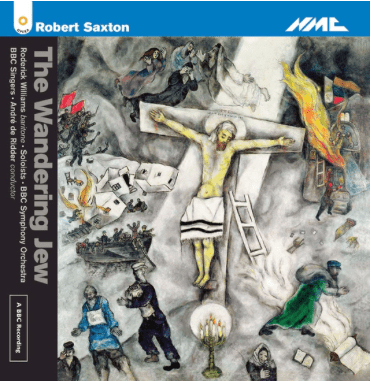
‘This is a powerful and extremely rewarding work which deserves the widest possible audience.’
Dominy Clements on The Wandering Jew, Musicweb International 2011
‘This project blew me away. Robert Saxton spent years writing his magnum opus, premiered on Radio 3 last July: an epic treatment of the Wandering Jew fable… Saxton’s tonal (or modal) musical language ranges from the cinematic spectacular to rapt spirituality.’
Richard Morrison, The Times
‘Robert Saxton’s viscerally energetic Fantazia, busily and brilliantly performed by a string quartet empathetic to the demanding textures of a powerhouse work which comes to a surprise ending of splendid inevitability.’
Christopher Morley, Birmingham Post, 2011
‘Carefully wrought and played with intense concentration, Saxton’s quartet is a substantial addition to the repertoire.’
Nick Kimberley on String Quartet No. 3, Evening Standard, 2011
‘The Maxwell Quartet … played Saxton’s String Quartet No. 3 (2011), capturing the contrasting character of each of the five movements with titles such as Winter Light and Dance. Ideas reveal and hide themselves in constant, delicate oscillation. In one (Sea Ground), he uses a passacaglia, mirroring the repeated yet changing action of the sea. This music, in this performance, had a mystery, delicacy and depth which made you want to hear it again immediately. What an exhilarating start to 2015.’
Fiona Maddocks, Observer, 2015
‘… Robert Saxton’s third String Quartet (premiered by the Ardittis in 2011), a superbly crafted work that navigates, like much of Saxton’s music, a wobbly bridge between tightly maintained and clearly articulated (mostly traditional) formal processes and the sense it conveys that everything might suddenly spiral off into unchained flights of extasy.’
Guy Dammann, Guardian, 2015
Presteigne Festival 2016: Composer in Residence
‘Based on the paintings by Stanley Spencer in Sandham Chapel in Hampshire, Saxton captured Spencer’s sense of mystical fantasy in a piece full of invention and striking writing for strings.’
Peter Reynolds on The Resurrection of the Soldiers, Hereford Times, 2016
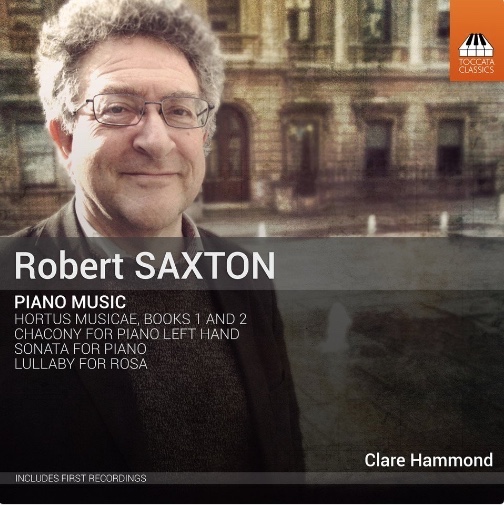
The Piano Music of Robert Saxton: CD
‘Saxton’s music is dynamic and ever-evolving… All in all, a fascinating glimpse into the mind of a musical iconoclast’ Lynn René Bayley, The Art Music Lounge, 2018
‘… the two volumes of Hortus Musicae are new to disc and evince piano writing no less idiomatic and arguably more personal than before. The inspiration is that of a ‘musical garden’ in all its allegorical and metaphysical implications, with the five pieces which comprise the First Book (2013) embodying this in ingenious ways – not least the stealthy (Andrew Marvell-inspired) floral clock of Hortus Temporis, or synthesis of formal precision and expressive eloquence in Hortus Infinitatis.’
‘Saxton has long been a composer able to fuse serial and tonal elements without the results seeming at all contrived or inhibited. The two books of Hortus Musicae abound in evocative and arresting musical imagery which Hammond conveys as convincingly as she realises the not inconsiderable technical challenges. … Lullaby for Rosa (2016) … a further instance of how deftly Saxton integrates technical ingenuity within a context of limpid wistfulness.’
Richard Whitehouse, Arcana, 2018
‘… the set opens with dense and resonant textures dredged from the murky depths of the piano’s low range before sweeping across the piano. … The virtuoso No. 7 provides a fitting and dramatic conclusion.’
Pwyll ap Siôn, Gramphone, May 2018
‘Saxton is adept at creating complex yet magical sound-words, the very transparency of the writing adding to the luminous quality. These gardens are by turns rhythmic, dramatic, light-fuilled, spare and meditative, and dancing, each different but each have a very particular quality which helps to define Saxton’s art.’
Robert Hugill, Planet Hugill, April 2018
‘These two collections are enchanting: at once playful and serious, exploratory, intellectually vigorous and, very often, deeply poignant.’
Kate Wakeling on Hortus Musicae, BBC Music Magazine, August 2018
‘… Robert Saxton’s evocative A Little Prelude for John McCabe … one of the most aurally beautiful contributions, Saxton’s piece is all the more eloquent through its simplicity of compositional means, the overlapping descending fragments leading to a final, radiant, consonance.’
David DeBoor Canfield, Fanfare, July 2018
‘Saxton’s sixteen-minute tone poem is an exquisitely intense affair. Altering between quasi-static chordal passages and sections of breath-taking vehemence, the music evokes striking sonic imagery, some entangled in mist and hue, others bathing in resplendent sunlight.’
Jari Kallio on The Resurrection of the Soldiers, Aventures in Music, 2021
Portrait CD
‘… highly inventive and immediately involving; admirably concise without quite being aphoristic. Especially fascinating is the fifty piece, a hushed evocation of bell-like sounds which seems to slow time, before the music plunges back into a passionate finale.’
Kevin Mandry on Fantasy Pieces, British Music Society, 2023
‘… the visceral immediacy of Jacob and the Angels, then the ethereal interplay in Bells of Memory, leading into Quest with (as in the song-cycle) a sense of this music having come full-circle yet simultaneously setting out fresh possibilities – tonal and emotional – to be pursued in future compositions.’
Richard Whitehouse on Suite, Arcana, 2023
‘… Saxton opts for six continuous items whose fluidity of content and intuitive follow-through readily point up the various connotations of the title. That the closing piece seeks to provide a definite resolution while imparting a sense of open-endedness to the sequence overall is merely the most arresting facet of this engaging work.’
Richard Whitehouse on Fantasy Pieces, Arcana, 2023
The Epic of Gilgamesh & The Resurrection of the Soldiers CD
‘…full of captivating music-making, two remarkable and compelling compositions, magnificently played…
The challenge arises from the fact that neither work is titled ‘symphony’. The Resurrection of the Soldiers (2016) is a searing, intense work for string orchestra, one that should by rights take its place among the finest English works for string orchestra. It falls into one continuous span, dividing naturally into three large paragraphs across a not-quite-quarter-hour timespan, and was written for the English Symphony Orchestra and George Vass (to whom it is dedicated) for the Presteigne Festival. Inspired by Stanley Spencer’s series of paintings for the Sandham Memorial Chapel, The Resurrection of the Soldiers is more tone poem, perhaps, but it has the gravitas of a one-movement symphony, not least through its central fugue and consolatory conclusion.
The larger piece, the five-movement Scenes from The Epic of Gilgamesh (2022) is another matter. This is the composition written for Woods and prompts the question: ‘What is a symphony?’ At one level, this is a closely argued suite derived from the great Mesopotamian text, around which Saxton had long wanted to compose a work. The musical language is broadly tonal and appealingly descriptive, its succession of vigorous sections and threnodies, and a finale worthy of Tippett at his best, echoing the trials of King Gilgamesh with his friend Enkidu. It is a haunting work, proving (were it needed) that musical impact or relevance need not come from extremes of sonority, harmony or style. The ESO respond with a fabulous interpretation, informed by immaculate ensemble and intonation (with some superb solo and duo playing along the way), one that stayed on loop in my player. Is it a symphony? In its scope, expressive élan and integration, I would say yes. Yet another thoroughly gripping, intriguing album, strongly recommended, as are its five predecessors. ‘
Guy Rickards, Gramophone, August 2024
‘The major work here is Scenes from the Epic of Gilgamesh (2023), commissioned by the English Symphony as part of its 21st Century Symphony Project. Saxton adamantly rejects the title of “symphony” for the work, though conductor Kenneth Woods asserts that it quite easily falls in the modern symphonic tradition—and I agree. Though it follows the Gilgamesh narrative, it doesn’t come off as a programmatic work—it has its own dramatic arc, thematic cohesion, and strength of purpose that would make it convincing as a stand-alone abstract work. The piece progresses unpredictably yet naturally, without expectations of traditional convention nor flashy surprising effects. I enjoyed the entire work, but particularly the bracing, anguished IV, `Lament on the Death of Enkidu’, the emotional and expressive heart of the piece.
Even better is The Resurrection of the Soldiers (2016), a stunning elegiac master-piece for string orchestra that can easily stand beside Vaughan Williams’s Tallis Fan-tasia. Inspired in part by Stanley Spencer paintings depicting World War I soldiers rising from their graves, it follows a cycle of resurrection, rebirth, and hope in a rigorous array of canons and fugues. It comes off as anything but academic, though; it is searingly intense and emotional, never letting the urgency of the moment cease. I’m struck once again by how the many harmonic and melodic developments feel so surprising yet so right. This is classical artistry at its best—craftsmanship, expression, and dramatic effect firing on all cylinders. Great performances and sound all around. Along with its Steve Elcock album (this issue), the English Symphony’s 21st Century Symphony Project has proved to be a fascinating, rewarding endeavor. FARO’
American Record Guide, September 2024

 ROBERT SAXTON